

Table of Contents
Capital goods jobs pay an average of $85,400 per year in the United States. But the range is wide. Entry-level workers earn around $40,000 per year. Top engineers and managers earn over $196,000 per year, according to Zippia salary research.
So the real question is: which role fits your skills, and what can you realistically earn?
This guide covers 12 of the most common capital goods jobs, their salary ranges, what they do, and what you need to get hired. All salary figures come from the U.S. Bureau of Labor Statistics (BLS) and Glassdoor.
What Are Capital Goods?
Capital goods are physical assets that businesses use to make other products. Think of machines in a factory, cranes on a construction site, or computers in a data center.
Some common examples:
- Industrial machinery
- Vehicles and forklifts
- Tools and equipment
- Buildings and warehouses
- Computers and production tech
The key difference from consumer goods: a consumer buys a loaf of bread. A business buys the oven that bakes it. That oven is a capital good.
The capital goods industry covers sectors like automotive manufacturing, aerospace, energy, construction, and electronics. According to the BLS, the industry supports nearly 6 million jobs across the United States.
What Do Capital Goods Jobs Pay? (12 Roles with Salaries)
Here is a breakdown of the most in-demand jobs in the capital goods sector, with salary data sourced from the BLS Occupational Outlook Handbook and Glassdoor (2026-2027).
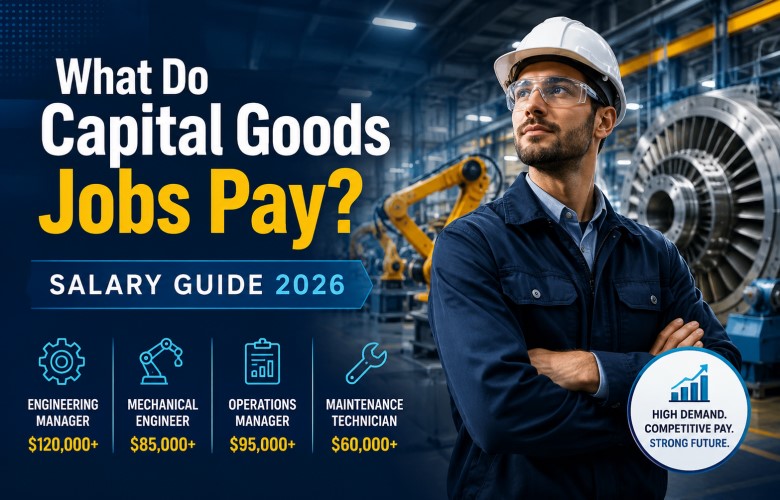
1. Engineering Manager
Average Salary: $130,000 to $196,000+ per year
Engineering managers lead teams of engineers and coordinate product development, testing, and production. They set project timelines, manage budgets, and solve technical problems that slow down output.
This is the highest paying role in capital goods. You need a bachelor’s degree in engineering plus at least 8 to 10 years of experience. Many employers also look for a PMP or MBA.
Job Growth: 4% over the next 10 years (BLS)
2. Mechanical Engineer
Average Salary: $85,000 to $120,000 per year
Mechanical engineers design and test machines, tools, and equipment used in manufacturing. They work on everything from conveyor belts to aircraft engines.
You need a bachelor’s degree in mechanical engineering. Many roles also ask for AutoCAD or SolidWorks skills. According to the BLS, the median annual wage for mechanical engineers is $99,510.
Job Growth: 11% over the next 10 years (BLS) faster than average.
3. Electrical Engineer
Average Salary: $95,000 to $130,000 per year
Electrical engineers design power systems, motors, radar equipment, and control systems for manufacturing plants. They also develop electrical components for vehicles and aircraft.
The BLS reports a median salary of $107,540 for electrical engineers. You need a bachelor’s degree in electrical engineering and familiarity with CAD software.
Job Growth: 9% over the next 10 years (BLS)
4. Capital Equipment Sales Representative
Average Salary: $90,000 to $160,000+ per year (with commission)
Sales reps in capital goods sell heavy machinery, industrial tools, and production equipment to businesses. This role rewards strong performers with commissions and bonuses that push total pay well above the base salary.
No specific degree is required, but a background in engineering or business helps. Strong communication skills and industry knowledge matter most.
Job Growth: 4% over the next 10 years (BLS)
5. Project Manager
Average Salary: $90,000 to $130,000 per year
Project managers oversee manufacturing projects from start to finish. They manage timelines, budgets, teams, and client expectations. In capital goods, this often means coordinating the production or delivery of large industrial equipment.
A PMP certification from the Project Management Institute gives you a significant salary boost. Many employers also want a bachelor’s degree in engineering or business. Glassdoor reports a median base salary of $95,000 for project managers in manufacturing.
Job Growth: 6% over the next 10 years (BLS)
6. Industrial Designer
Average Salary: $65,000 to $95,000 per year
Industrial designers create the layout and function of manufactured products and production equipment. They blend engineering knowledge with design thinking to improve how machines work and how safe they are.
A bachelor’s degree in industrial design or mechanical engineering is standard. Proficiency in 3D modeling software is a must. The BLS reports a median salary of $77,030 for industrial designers.
Job Growth: 3% over the next 10 years (BLS)
7. Supply Chain Analyst
Average Salary: $60,000 to $90,000 per year
Supply chain analysts track the flow of raw materials, parts, and finished goods through the production process. They find bottlenecks, cut costs, and improve delivery timelines.
A bachelor’s degree in supply chain management, business, or logistics is common. Certifications like APICS CSCP add real value. Glassdoor shows an average base of $72,000 for supply chain analysts in manufacturing.
You can learn more about managing business resources and operations on this site.
Job Growth: 28% over the next 10 years (BLS) much faster than average.
8. Quality Assurance Manager
Average Salary: $75,000 to $110,000 per year
QA managers set quality standards and run inspections to make sure products meet those standards before they leave the facility. They track defects, run audits, and train teams on compliance procedures.
A bachelor’s degree in engineering or manufacturing is typical. Six Sigma and ISO 9001 certifications are valuable. Indeed reports a national average salary of $78,843 for QA managers in capital goods.
Job Growth: 5% over the next 10 years (BLS)
9. CNC Machinist
Average Salary: $45,000 to $70,000 per year
CNC machinists operate computer-controlled machines that cut, shape, and drill metal parts used in manufacturing. They read technical blueprints and set up machines for each production run.
You can enter this role through a technical school program or apprenticeship. No four-year degree is needed. The BLS reports a median wage of $50,840 per year for CNC machinists.
Job Growth: 7% over the next 10 years (BLS)
10. Maintenance Technician
Average Salary: $48,000 to $75,000 per year
Maintenance technicians keep machines and production equipment running. They diagnose mechanical and electrical faults, replace broken parts, and prevent downtime on the factory floor.
Most roles ask for a technical degree or vocational training. OSHA safety certification is often required. Experienced technicians in high-demand industries like aerospace and energy earn toward the top of this range.
Job Growth: 6% over the next 10 years (BLS)
11. Welder / Fabricator
Average Salary: $40,000 to $60,000 per year
Welders and fabricators join metal parts together to build industrial structures and equipment. They work in manufacturing plants, shipyards, and construction sites.
No degree is required. Vocational training and AWS welding certification get you hired. The BLS reports a median annual wage of $49,490 for welders and fabricators.
Job Growth: 3% over the next 10 years (BLS)
12. Logistics Coordinator
Average Salary: $45,000 to $70,000 per year
Logistics coordinators schedule shipments, manage inventory, and make sure finished goods reach customers on time. In capital goods, this often involves moving large, heavy equipment across regions or internationally.
A degree in logistics, supply chain, or business is helpful but not always required. Strong organizational skills and experience with ERP systems like SAP matter most.
Job Growth: 18% over the next 10 years (BLS) strong demand.
Salary Summary Table
| Job Title | Average Salary | Education Needed |
|---|---|---|
| Engineering Manager | $130,000 to $196,000+ | Bachelor’s + 10 yrs exp |
| Electrical Engineer | $95,000 to $130,000 | Bachelor’s in EE |
| Capital Equipment Sales Rep | $90,000 to $160,000+ | No specific degree |
| Project Manager | $90,000 to $130,000 | Degree + PMP cert |
| Mechanical Engineer | $85,000 to $120,000 | Bachelor’s in ME |
| QA Manager | $75,000 to $110,000 | Bachelor’s + Six Sigma |
| Supply Chain Analyst | $60,000 to $90,000 | Bachelor’s in SCM |
| Industrial Designer | $65,000 to $95,000 | Bachelor’s in ID |
| Maintenance Technician | $48,000 to $75,000 | Vocational training |
| CNC Machinist | $45,000 to $70,000 | Technical school |
| Logistics Coordinator | $45,000 to $70,000 | Degree or experience |
| Welder / Fabricator | $40,000 to $60,000 | Vocational + cert |
Sources: U.S. Bureau of Labor Statistics, Glassdoor, Zippia (2025-2026)
What Affects Your Pay in Capital Goods?
Your title alone does not determine your salary. These four factors play a big role:
1. Experience and Education
More years on the job means higher pay. A mechanical engineer with 2 years of experience earns around $70,000. The same engineer with 15 years and a master’s degree can earn $130,000+. Certifications like Six Sigma, PMP, and OSHA also push salaries up.
2. Industry Sub-Sector
Not all capital goods sectors pay the same. Aerospace, defense, and energy tend to pay more than general manufacturing. A maintenance technician at a defense contractor will earn more than one at a small auto parts plant.
3. Location
States like California, Texas, Washington, and Michigan offer higher wages for capital goods roles. But cost of living matters too. A $110,000 salary in Houston goes further than the same pay in San Francisco. You can use the BLS state wage data to compare by location.
4. Company Size
Larger companies like Caterpillar, Boeing, Honeywell, and General Electric tend to pay more and offer better benefits than smaller regional manufacturers. They also invest more in training and certifications, which increases your long-term earning power. Check open roles and company reviews on Glassdoor before you apply.
Is a Career in Capital Goods Worth It?
Yes, for most people it is a strong career choice. Here is an honest look at the trade-offs:
| Pros | Cons |
|---|---|
| Salaries above the national average | Some roles are physically demanding |
| Strong job stability in most sectors | On-site work, limited remote options |
| Clear career growth path | Safety risks in industrial environments |
| Demand stays steady even in downturns | Technology changes require ongoing training |
| Skills transfer across industries | Best-paying jobs cluster in specific regions |
The national median wage for all U.S. workers sits at $59,228 (BLS 2024). Most capital goods roles pay well above that, even at the entry level.
If you enjoy hands-on work, problem-solving, or building physical products, this sector offers real financial rewards and long-term job security.
How to Get a Capital Goods Job
Follow these steps to break into the industry:
Step 1: Pick your path Decide whether you want a trade role (welder, CNC machinist, technician) or a professional role (engineer, analyst, manager). Trade roles need vocational training. Professional roles need a degree.
Step 2: Get the right credentials
- For trade roles: enroll in a community college or vocational program. Look for OSHA 10 or OSHA 30 safety certification.
- For engineering roles: get a bachelor’s degree in mechanical, electrical, or industrial engineering.
- For management or sales: add a PMP, Six Sigma, or an MBA to your profile.
Step 3: Build hands-on experience Apply for internships, apprenticeships, or entry-level positions. Hands-on experience matters more in this sector than it does in many others. Most employers want to see real shop floor or project experience.
Step 4: Search the right places Find open roles on LinkedIn Jobs, Indeed, and the BLS CareerOneStop tool. Many large manufacturers also post directly on their own websites.
Step 5: Track your finances as you grow As your income grows, use smart tools to manage it. Our business loan calculator helps you plan major purchases, and our finance articles cover how to grow your money alongside your career.
Frequently Asked Questions
Engineering Manager is the highest paying role in the capital goods sector. Experienced managers at large companies earn between $130,000 and $196,000+ per year.
The average salary for capital goods jobs is around $85,400 per year in the United States, according to Zippia. Entry-level positions start near $40,000, and senior roles can go well past $100,000.
Not always. Trade roles like CNC machinist, welder, and maintenance technician do not require a degree.
Yes. The BLS projects capital goods occupations to grow by 4 to 28 percent over the next decade, depending on the role. Supply chain analysts, logistics coordinators, and mechanical engineers face the strongest demand.
California, Washington, Texas, Michigan, and Ohio offer some of the highest wages for capital goods workers.
Bottom Line
Capital goods jobs pay well across the board. The average sits at $85,400 per year, and the ceiling goes well past $196,000 for experienced managers and top-performing sales reps.
The sector rewards people who build real skills. Whether you start on the shop floor as a welder or enter as an electrical engineer, clear career paths and strong salary growth make this industry worth serious consideration.
Ready to build your career? Start by exploring business growth strategies and finance tips to set yourself up for long-term success.
